This is part of our Hockey 101 series: positioning and team systems for beginner and intermediate players, and for teams that never get a practice.
Offensive zone structure
Until the 1970s, most hockey was played with fixed sides for the length of the ice: left wing stayed left, right wing stayed right, center stayed center.
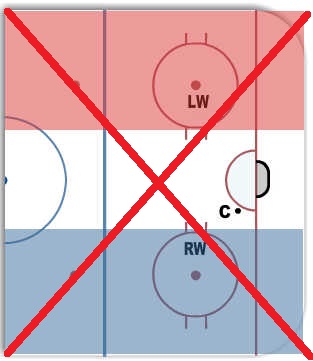
The Soviet teams showed that was not the best way to play. Modern offensive systems do not lock forwards to one side of the ice for the whole shift.
F1, F2, F3
Today most coaches talk about offensive positioning in terms of three interchangeable roles (F1, F2, and F3) instead of center and wings. Offensive zone play is about creating chaos for the defense while still controlling the puck in a structured way.
Attackers can occupy plenty of spots in the offensive zone. One structure keeps showing up, and it is the one beer league lines should learn first.
Attack Triangle
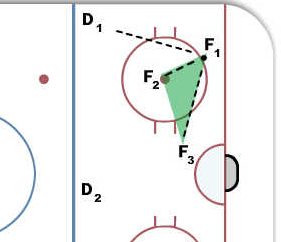
In the offensive zone, forwards should work to keep a triangle. That shape does two useful things:
- You always have multiple passing options with different angles on the net.
- Every spot in the triangle offers puck support.
If the triangle is set, a forward should rarely be without a pass. That is the same front side and back side support you want everywhere: a teammate closer to the scoring area, and a teammate behind the carrier or in a safer, more defensive spot. Net-front is the most common front side option. The high forward, or F3, is often the back side outlet. Like any rule of thumb, you can break it for a set play, but start here.
Three habits that matter
A few habits make offensive zone time productive instead of chaotic.
- Stay in the scoring area. At least one player should remain in front of the net to collect rebounds, take passes, and force defenders to respect that spot. That player is usually your front side option, the more dangerous pass.
- Find soft spots. Keep moving into quiet ice where you have time and space to catch a pass and get a shot off.
- Support the puck carrier. The forward closest to the puck balances being open and being in the scoring area with the need to help. Be available if the carrier drops it or gets tied up on the boards. That low help is often back side support, while the teammate closer to the net is the front side pass.
A common beer league mistake is floating far away from the puck to "get open." Stop thinking about being open. Think about finding a front side or back side angle of support for the player with the puck.
For how this triangle shows up on the rush, and a few set plays built on it, read Hockey 101: Offensive Zone Entry (Wide Drive).
Quick checklist
- Drop the old fixed-side habit. Play F1, F2, F3.
- Hold the Attack Triangle so there is a front side option and a back side option.
- Keep someone in front of the net.
- Move into soft spots; do not stand still.
- Give the carrier a front side option and a back side option, instead of floating "open" across the ice.
When you lose the puck in the zone, the next job is pressure: a simple 1-2-2 forecheck keeps the fight in their end instead of a free exit.
Bottom line
Fixed sides are dead. Interchangeable F1/F2/F3 roles plus the Attack Triangle give your line structure without killing creativity. Stay in the scoring area, find soft ice, and give the carrier front side and back side support. Run that every shift and your team will generate more than three guys parking in their "spots."
It works best when the same line plays together every week. If your lineup still gets sorted out by group text, that is what RosterFX is for.
Keep reading: Hockey 101: 1-2-2 Forecheck · Hockey 101: Offensive Zone Entry · Hockey 101: Puck Support · Hockey 101: Basic Power Play Formations · More Hockey 101